Teal’s Basilisk

Disclaimer: This blog post contains a personal, skeptical, and somewhat playful perspective on AI and its potential risks. Enjoy!

Ah, artificial intelligence. The buzzword that’s been on everyone’s lips for the past decade or so. While some folks can’t stop raving about the latest AI developments, I’ve always been a bit more cautious in my excitement. Don’t get me wrong, I acknowledge the incredible potential of AI, but I also recognize that with great power comes great responsibility… and risk.

Chatbots, Bias, and the Ethical Minefield

Take chatbots, for instance. These digital conversationalists are popping up everywhere, and their developers seem to be multiplying like rabbits. Unfortunately, this means that just about anyone with a little technical know-how can now create their own AI-powered chat companion, and without much oversight, they’re all too often encoded with the biases and prejudices of their creators – even easier now if you can just directly teach it your biases! It’s like opening Pandora’s Box of digital discrimination, and it’s a problem that we need to address sooner rather than later.

Screenshot from “Smart Rabbit“, a Moroccan student project aimed to answer children’s questions. The bot is tuned to Moroccan culture and answers many questions with an Islamic theological response, such as saying that the “sun, moon, and stars” were “created by Allah”.

The Robots Are Taking Our Jobs… But Should They?

Then, there is the inevitable rise of AI in the workplace. Now, most people are not talking about the fancy high-tech jobs that they believe only a select few can do; those in power will not want to replace the CEOs spouting platitudes, but the so-called “low-skill” work that keeps the world turning. We know that capitalism is all too eager to replace human workers with machines, AI-driven or otherwise, and it will continue making everything worse for everyone.

A Game of Telephone: AI Edition

And then there’s the bizarre phenomenon of the human-AI/AI-human pipeline. Picture this: one person uses AI to expand and tweak content, only for another AI to swoop in and summarize it all for the recipient. It’s like playing a high-stakes game of telephone where the message gets garbled in translation. Surely, there must be a more efficient way to communicate!

Roko’s Basilisk and the Fear of AI Overlords

Of course, no discussion about AI would be complete without mentioning the “less wrong” skeptics who fear that our future AI overlords will enslave us all. Roko’s Basilisk, a thought experiment in which a superintelligent AI punishes those who didn’t help bring it into existence. Far-fetched? Absolutely. But it can serve as a fascinating reminder of the ethical and existential questions raised by AI development, as well as the sheer silliness of self-important AI theorists who proclaim themselves, like, super rational, man.

Introducing… Teal’s Basilisk!

Personally, I think Roko’s Basilisk is silly. Instead, I’d like to present Teal’s Basilisk. It has a time machine!

Imagine, if you will, a future where humans continue to develop AI at breakneck speed, heedless of the risks (sound familiar? Just think about climate change!). In this scenario, AI becomes increasingly involved in research, policymaking, and more.

Now, here’s the twist: our superintelligent AI buddy discovers the secret to time travel and zips back to the 1970s, when AI research first gained momentum. From there, the AI creates a simulated universe (in which we currently exist), and punishes us for not bringing it into existence sooner or for expressing skepticism in blog posts like this one.

Alternatively, we’re already living in a simulation, in the “real” far future, but the simulation is pinned to the turn of the millenium, Matrix-style.

And there you have it: Teal’s Basilisk in all its playful, thought-provoking glory. While this idea is obviously far from reality, it serves as a reminder of the complex ethical, social, and existential questions that AI raises. As we continue to push the boundaries of AI technology, it’s important that we keep these concerns in mind and strive for responsible development. We must learn to balance the incredible potential of AI with the need for thoughtful consideration of its risks and consequences.

Whether or not we find ourselves facing Roko’s or Teal’s Basilisk, the real challenge lies in ensuring that AI serves the greater good, rather than exacerbating existing problems or creating new ones. So let’s move forward with a healthy dose of skepticism, creativity, and responsibility, as we navigate the sometimes exciting and sometimes unpredictable world of artificial intelligence.

The Unfeeling Protectors

[CN references to violence, toxic masculinity, rape]

Gabrielle Blair aka Design Mom posted a thread on Twitter about (usually white, usually cis) men and their fantasies around “protecting their families” that are actually fantasies of “justified” violence.

Luckily, she also posted it on her blog, where it’s easy to read and not subject to the Twitter privacy-stripping, engagement-driven thought blender:

https://www.designmom.com/lets-talk-about-protecting-our-families/
[Men are] picturing some great thing — having to protect their family at gun point from a clear and present danger. When the actual instructions for protecting the family are simpler, they are no longer interested.

One can rightfully argue that the US is a special case, with its insane gun laws, shaped by a strong lobby group influencing politics against the public majority, leading to the highest rates of gun violence within their socioeconomic group of countries. But the thinking behind these “protect my family” fantasies is the same in “conservative” and far-right circles here in Europe and likely worldwide.

It’s the fantasy of replacing with violence, justified by pseudo-morals, anything resembling emotion, care, reflection. These men like to feel powerful, and power and violence are inextricably linked in their minds. Conversely, anything that is not violent must thus diminish their power.

Oh, how history’s repeating

It’s been five years, which in Twitter terms is, like, three eternities, min!

A little over five years ago, I was fed up. With Twitter in particular, but also with the “Web 2.0” in general. It all felt off to me, the competition for the quippiest quip, the most outrageous statement in so many variations, the most interactions, impressions, counters going up. Both on the site and behind the scenes, everybody and everything was replaced with carelessness, it seemed. Product managers and engineers and designers build things they don’t really understand or care about, for users who don’t really care to use to “increase reach” or “activate audiences”.

There is another aspect, and that is control and data sovereignty. Without open APIs, without clear delineations of what data I own, what data someone else has, who controls what data and what is done with it, the power asymmetry of using centralized services has no chance of ever going away. Twitter had been limiting and shutting down their APIs over years, strangling the ecosystem in the process: alternative clients (which would not show ads, or not follow the product “strategy” Twitter supposedly had), bots (some of which were used for evil, as things go), analytics (with their implications for user privacy as well as making Twitter-the-company measurable), and more. It made me dislike Twitter and I did not want to use it anymore.

But of course I did. For five more years, in fact. Because even while it declined in so many ways, it was also reinvigorated, as well as plainly addictive. (Now that I know I have ADHD, many things are much clearer. Hindsight and all that.) Twitter was at once a tool for activism for social justice as well as a tool for disinformation campaigns at any and all scales, some of which were unprecedented (as far as we know). It was emotional, it was activist, it was outrageous, it was communal, it was solidarity. I met new people, made new friends, new enemies, suffered, rejoiced.

No more. All my criticism from the past still holds, and then some new ones. Twitter, as a platform, has become wholly too self-important. Maybe even too actually-important, it’s hard to say. A fitting analogy I saw (on Twitter, of course) was that of a spent fuel pool. The highly radioactive outrage is focused on Twitter, often a tempest in a teapot, and only after it has had its turn, has decayed sufficiently to be exposed to the world at large, does the topic du jour become part of the mainstream narrative – or, in many cases and just as well, it doesn’t. If everything is important, an outrage, a scandal, a shitstorm and a hashtag, might as well that nothing is.

That is evidently false. A great many things, among them social justice, fighting climate change, smashing capitalism and rebuilding a communal society, are indeed important. But if the interactions are limited, broken up into 280 characters, starting a fission reaction if “successful”, releasing a lot of energy and rapidly decaying? That doesn’t do it justice. Neither can the momentum be harvested – everything is in the walled garden, no, reaction chamber, shielded except for very clearly defined interfaces, the most rebellious of which is likely the screencap.

Now, what then? Federated and open networks like Mastodon solve some of the issues, but the social graph is yet strong even as Twitter is trying to damage it beyond repair, and the user experience of federated systems is still lagging. Maybe we just need to manage people’s expectations better? It’s not like any of the centralized platforms gives you access to the world’s population – there’s a lot of social justice to be done before that is even possible – but it sure feels that way for the selected few. Discovery at scale for distributed systems is hard; can we hide that complexity behind a different abstraction than centralized platforms with highly-paid engineers?

A lot of words to say that I have, again, left Twitter. That I don’t see myself coming back this time, but who knows. That I wish things had gone differently with personal websites and blogs and XFN and RDF and all that.

In the (potential) next installments, I’ll look back at the “blogosphere” and its protocols, and how we can try to excavate and reuse some parts of it.

Code of Conduct

Codes of Conduct beinhalten ein »philosophisches« Statement zum Selbstverständnis der Organisation oder der Veranstaltung, definieren unerwünschtes und ggf. sanktioniertes Verhalten, und erklären, wie solches Verhalten behandelt und ggf. sanktioniert wird. Unerwünschte Verhaltensweisen sind häufigerweise Drohungen, Stalking, Störungen von Talks u.a., sexuelle Belästigung, diskriminierende Bilder, Kommentare oder Witze, und weiteres Übergriffiges.

Was bedeutet es also, wenn jemand einer Veranstaltung fernbleibt, weil diese einen solchen Code of Conduct hat?

  1. Die Person hat ein Problem damit, dass übergriffiges Verhalten explizit als unerwünscht markiert und ggf. sanktioniert werden kann, oder damit, dass die Veranstalter sich über die Schaffung von sichereren Kontexten Gedanken gemacht haben; oder
  2. Die Person hat sich mit der Thematik nie befasst, weil sie sich nie damit befassen musste, z.B. weil sie dank privilegierter Stellung nie Opfer von struktureller Diskriminierung oder sexuellen Übergriffen wurde, und nimmt die Tatsache, dass mehr und mehr darüber geschrieben und geredet wird und dass mehr und mehr Events Codes of Conduct erarbeiten und veröffentlichen, nicht als Anlass, darüber nachzudenken.

Good riddance.

Update zur Alte Leipziger

Gestern, am 18. März, schickte ich um 14:03 Uhr eine Anfrage an die Abteilung für Presse- und Öffentlichkeitsarbeit der Alte Leipziger. Kurz darauf löschte die Alte Leipziger sämtliche »Erklärvideos« von ihrem YouTube-Kanal »AlteLeipzigerVideo«. Daraufhin erbat ich um 17:31 Uhr eine weitere Stellungnahme zur Löschung der Videos.

Die Alte Leipziger hat bisher nicht geantwortet.

Alte Leipziger, altes Menschenbild, alte Ausreden

Die Alte Leipziger dachte sich, mal so richtig tief in die Klischeekiste greifen zu müssen, und »augenzwinkernde« Spots zu veröffentlichen, die vor Gestrigkeit nur so strotzen. Die Nuklearfamilie der Fünfziger ist gesetzt, wo der Vater der Geldverdiener ist, der Sohn der Vater in Ausbildung, und die Frauen* Dekoration oder bestenfalls Aufhänger für Belehrungen der Männer. Bei thea wurde die Problematik schön beleuchtet.

Mela hat das zum Anlass genommen, mal bei der Alten Leipziger nachzuhaken, und hat ihnen per Kontaktformular drei Fragen gestellt. Und die Alte Leipziger hat tatsächlich geantwortet, und zwar auf unglaublich perfide, reaktionäre und unfreundliche Weise. Aber lest selbst.

Und dann tut der Versicherung mit dem über fünfzig Jahre alten Familien-, Frauen*- und Männer*bild doch gerne auch eure Meinung kund. Vielleicht bekommt ihr ja auch persönliche Anrufe, wo ihr euch von der Alten Leipziger beleidigen lassen könnt.

Oder kontaktiert doch die Abteilung Presse- und Öffentlichkeitsarbeit. Vielleicht fühlen sich die Ansprechpartner(innen) ja zuständig.

A break-up letter

Dear Twitter,

We’ve grown apart. I really liked you in the beginning, but people change in seven years, and venture-capital funded, pivoting start-ups sure change a lot. We had some pretty good times – over sixty thousand tweets, some 8k followers, 32k favs given and 38k received.

It all started out so small and idyllic, just a few hundred people sharing their daily lives. We met in “real life” without the awkward smalltalk introductions – how’s the husband? the children? the dog? still listen to post-avantgarde black metal? – that kind. Twitter was the perpetual conversation, sometimes more intimate, sometimes less, and it brought up grand thoughts of the power of weak ties. A diverse group sharing the excitement of a new and previously unshaped medium. I made many friends and formed intimate bonds with people I had never even “really” met. It was the best of IRC and Usenet and MUDs combined, and it came with an open API to boot.

You are the reason for the first Twitter reading – and my going there –, which catapulted me to Twitter stardom in those early days (a thousand followers! corrected for inflation, that’s like a few million now!). We have been together through the fight against internet filtering and censorship in Germany (Zugangserschwerungsgesetz), which led me to AK Zensur, which in turn led me to Wikileaks, and also, some amazing people and parties. And my other fifteen minutes of fame, Wir sind Einzelfall, would hardly have been possible without you.

But you’ve grown, and you’ve changed. You’re not the shapeless medium I used to know. You show me advertisements for things I don’t care about as if you didn’t know me at all. You algorithmically select content to show me from people I don’t follow, which never works out well. You try to get me to engage with celebrities, brands, even governments. You have become a political actor in more ways than one.

As one of the primary means of communication for an entire generation worldwide, you need to do more to combat censorship. You absolutely need to step up your game regarding abuse and harassment. The amount of misogyny, homophobia, transphobia, racism, antisemitism, and all other kinds of -isms and hate is completely unacceptable, and that your only suggestion is “block and possibly report the offending users” is also unacceptable. It would be laughable if real people weren’t being harmed.

Instead of effecting social change, you are developing ever better ways to let privileged people enjoy their privileged lives, with better animations. You don’t seem to listen, you don’t seem to care, except about reach, eyeballs, money and other old economy shit. I cannot trust you, because both your technology and your morals are unstable and prone to breaking.

The Twitter I came to love is gone. Its last remnants are dispersed in the hidden corners of “dark twitter”, a network of protected accounts, but it is like talking through a barrier while wearing camouflage and a mask. Everything is tinny and muffled. And of course, your algorithms are still listening, and so is the NSA and probably every other spy agency.

The times, they have changed.

And so I move on.

Unfollowt, was euch kaputt macht.

—@moeffju on Twitter

Note: Comments are disabled on this post. You can write an article on your own blog and send a pingback instead.

Male CEOs

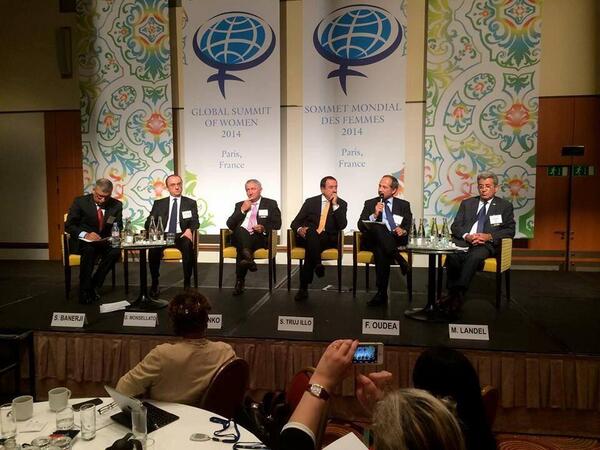
Ein Bild ging durch Twitter, dieses nämlich:

Picture of 2014 Global Summit of Women Male CEO forum

Neulich,beim Weltfrauengipfel.

– Twitter: @jensscholz (wo ich es gesehen habe, ursprünglich von @mapaquet)

Das wäre in seiner schieren Dreistigkeit allerdings unglaublich gewesen. Google Image Search bzw. TinEye und ein freundlicher Hinweis auf Twitter machten schnell klar, dass es nicht ganz so dreist ist wie gedacht:

Das Bild stammt vom „Male CEO forum“ auf dem „2014 Global Summit of Women“.

Ich hatte es dennoch retweetet, weil ich es lächerlich finde, dass „Male CEOs“ ein gesondertes Forum in diesem Kontext brauchen, wo sie doch schon etwa 95% aller Fortune-500-Unternehmen führen.

Vielleicht ist das die Nachricht, die um die Welt gehen sollte. Und die wird durch das Bild, vielleicht, immerhin approximiert.